


Many lawn owners apply fertilizer or seed in spring, yet the lawn often does not respond because the problem is not on the surface but in the soil. When you understand the condition of your soil, you can act with precision and save time, money, and stress for the grass.
Why does a lawn sometimes grow poorly?
The most common reasons:
-
compacted soil that suffocates roots
-
water standing after rain
-
nutrient imbalance
-
unsuitable pH level
-
lack of organic matter
A soil sample quickly reveals what your lawn is missing.
What does a soil analysis show?
A soil analysis provides information about:
-
soil pH
-
nitrogen (N) — the main regulator of growth
-
phosphorus (P) and potassium (K) — affect root development and resistance
-
magnesium (Mg) and calcium (Ca) — important for lawn color and stability
-
organic matter — improves soil structure and moisture retention
Recommendation:
For a home lawn, a basic analysis (pH, N, P, K) is sufficient. For professional lawns or more demanding gardeners, include Mg, Ca, and organic matter.
When is the right time for analysis?
-
early spring — before fertilization begins
-
or autumn — after the growing season ends
This helps you understand what your lawn actually needs and apply fertilizer exactly where it makes a difference.
How to take a soil sample
Accurate results depend on proper sampling:
-
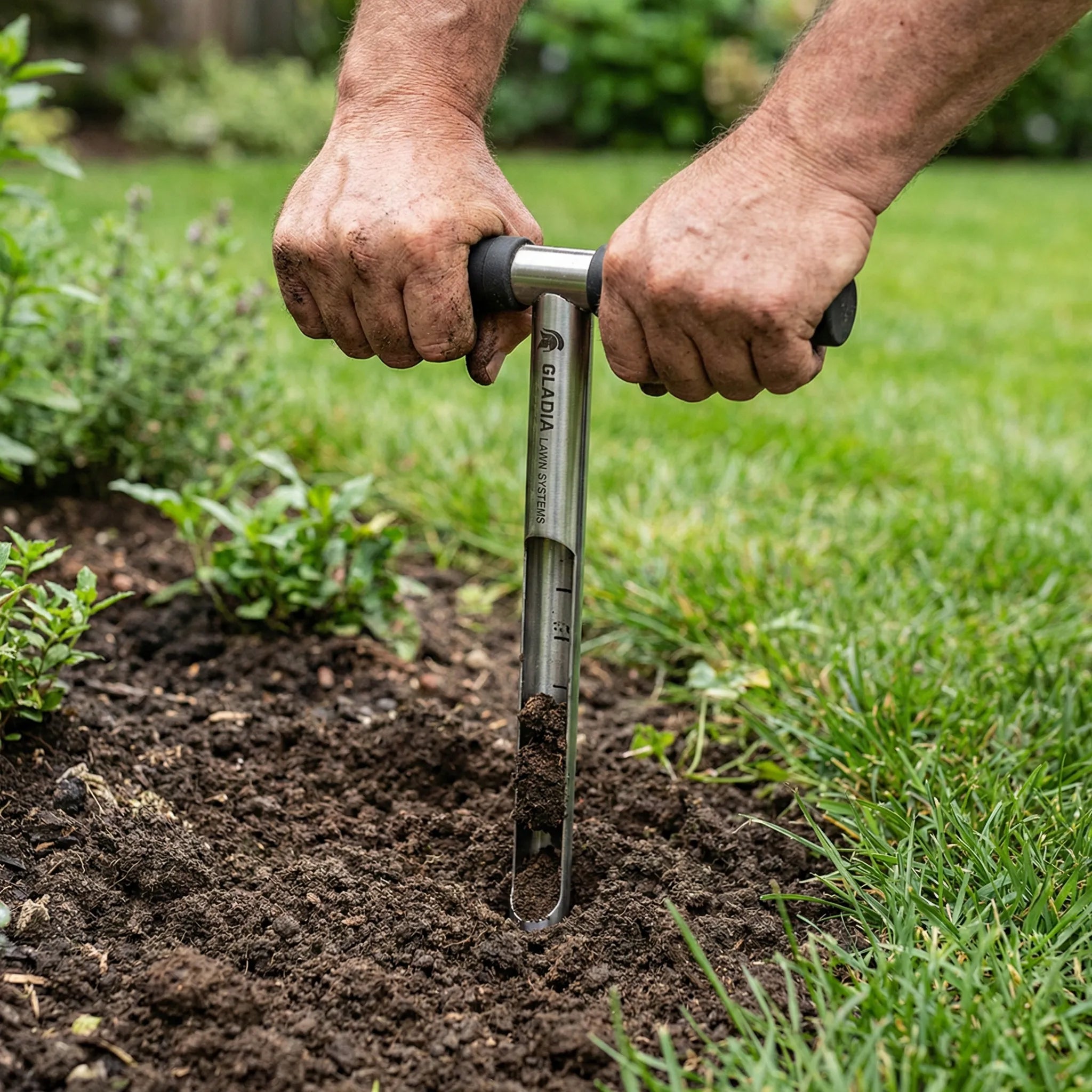
Take 10 samples across the lawn. At a depth of 100 mm using the GLADIA probe, this equals about 0.5 kg of soil. Samples should be stone-free and taken from different lawn areas.
-
Push the probe straight into the soil and remove the core.
-
Combine all samples in an airtight, clean PVC bag.
Recommended sampling depths:
-
75–100 mm — basic lawn analysis
-
100–150 mm — when growth problems or drought occur
-
150–200 mm — for checking compaction or soil structure
The GLADIA probe includes measurement markings every 25 mm, allowing precise sampling.
Tip:
If you struggle to push a screwdriver into the soil, the ground is likely compacted and your lawn needs aeration.
Conclusion
Do not guess — check what is happening below the surface.
After laboratory analysis you will:
-
fertilize accurately
-
prevent mistakes
-
speed up lawn growth
-
achieve a healthy, dense lawn
-
save money by buying the right fertilizer
Investing in soil analysis tools is worthwhile. Their value equals a bag of quality fertilizer that may not even be necessary for your lawn.
The GLADIA probe is an essential tool for home gardeners and professionals who want to achieve a perfect lawn using a precise, data-driven approach.
Nasvet strokovnjaka: Mah na zelenici - vzroki in trajne rešitve